Build TikTok Search Moat Before Competitors
Learn how to build a TikTok search content moat by saturating keywords with multiple videos before competitors rank. May 2026 strategy guide.


You're losing customers in TikTok search results because your competitors figured out how to saturate keyword queries while you were focused on the For You Page. Building a TikTok search content strategy requires owning multiple video spots for the same search term, creating a barrier competitors can't easily break through. The ranking signals are completely different from Google. Watch time, spoken keywords, and on-screen text matter more than any authority metric. Get this right before your category fills up, and you own those queries for the long term.
Why TikTok Search Matters More Than Your Traditional SEO Strategy
Search behavior changed faster than most marketers expected. Here's the strategic reality: TikTok search doesn't replace Google. It runs alongside it. When someone searches "best pre-workout for college athletes" on TikTok, they're in a different discovery mindset than a Google searcher. They want to see a product in action, not read about it.
Brands treating TikTok search as optional are leaving discovery intent on the table. The customer journey now spans two search ecosystems, and optimizing for only one means you're invisible in the other.
The Content Moat Concept Applied to Social SEO
A content moat in traditional SEO means owning so much topical territory around a subject that competitors struggle to displace you. The same logic applies to TikTok search, but the execution looks different.
On Google, you build moats through backlinks and domain authority. On TikTok, you build them through search result saturation. When a user searches a keyword relevant to your brand and multiple videos from your account appear, you own that query. Competitors have to displace multiple videos to break through.
This shift is no longer new. As far back as 2022, Google's own internal data found that nearly 40% of Gen Z was turning to TikTok or Instagram instead of Google Search or Maps, and that behavior has only deepened since. By 2026, those search habits are locked in. Your brand can capture them or cede them to someone else.
How TikTok Search Ranking Differs From Google SEO
Google ranks pages. TikTok ranks videos on signals that look nothing like traditional SEO.
TikTok runs two separate discovery systems. The For You Page rewards novelty, trend alignment, and broad engagement. The search results page works differently: it weighs relevance signals embedded directly in the video content itself, not the account behind it.
There are five ranking factors that matter for search:
- Watch time when a user searches a specific query, which tells the algorithm the video answered what someone was looking for
- On-screen text matching the keyword, making captions and overlays searchable content in their own right
- Spoken keywords in the audio track, which TikTok actively indexes through speech recognition
- Engagement velocity in the first 24 hours, particularly from users who found the video through search
- Saves and shares as user intent signals, since these indicate the content had lasting value worth returning to
Backlinks don't exist here. Domain authority means nothing. A brand-new account can outrank a legacy competitor if the video nails these signals. That's the actual opportunity worth acting on now.
| Ranking Factor | TikTok Search | Google SEO |
|---|---|---|
| Primary Signal | Watch time from users who searched the specific query, measured within the first 24 hours after posting | Backlinks from authoritative domains and overall domain authority built over months or years |
| Content Format | Video-native content with spoken keywords, on-screen text overlays, and visual demonstrations of products or concepts | Written articles with structured HTML, header tags, meta descriptions, and keyword-optimized body text |
| Keyword Indexing | Speech recognition transcribes audio, indexes on-screen text as searchable content, and reads video captions for relevance matching | Crawlers parse HTML structure, meta tags, alt text, and written content to determine topical relevance |
| Engagement Metrics | Saves and shares signal lasting value, comment velocity indicates relevance, completion rate measures intent match | Click-through rate from search results, time on page, bounce rate, and internal linking patterns |
| Authority Building | Account age and follower count carry minimal weight compared to individual video performance on target queries | Domain age, backlink profile quality, topical authority across multiple related pages over time |
| Competitive Moat | Saturate search results with multiple videos per keyword to own the query and block competitor displacement | Build backlinks, create pillar content clusters, and earn domain authority to defend ranking positions |
Keyword Research for TikTok Search Dominance
TikTok's search bar is a research tool, and your keyword strategy needs to reflect that. Users type queries with clear intent, so matching that intent is the starting point for any content moat.
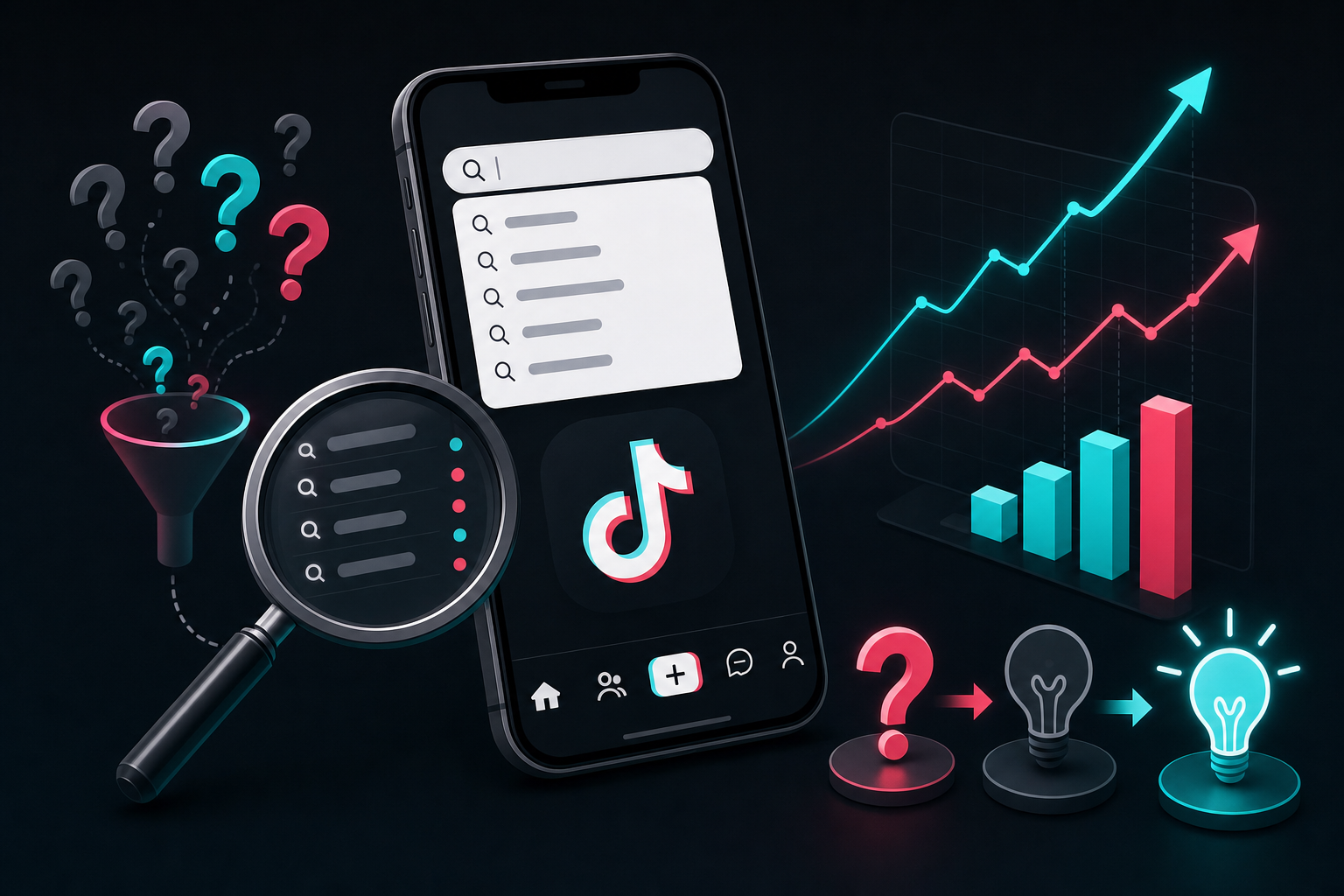
Start by typing your core topics directly into TikTok's search bar and studying the autocomplete suggestions. These are real queries from real users, not estimates. Cross-reference with Google Trends to spot rising interest before it peaks.
Focus on Question-Based Keywords
Question keywords signal high search intent and low competition compared to broad terms. Focus on these angles:
- "How do I" queries tied to your product category tend to surface buying-stage intent, putting your brand in front of users ready to act.
- "Best [product] for [specific use case]" searches attract comparison shoppers who convert at higher rates than passive browsers.
- Niche problem-based queries often have almost no existing TikTok content, leaving the first-mover position completely open.
Optimizing Video Content for TikTok Search Rankings
TikTok's search algorithm weighs several factors when deciding which videos rank. Keyword placement matters more than most brands realize.
Your target keywords need to appear in three specific places: the spoken audio, the on-screen text or captions, and the written description. When all three align, TikTok's algorithm reads your content as highly relevant to that query.
Where Keywords Actually Move the Needle
Beyond placement, there are structural choices that consistently influence rankings:
- Put your primary keyword in the first line of your caption, since TikTok indexes this text heavily and cuts off descriptions after roughly 150 characters in search results.
- Spoken keywords carry weight because TikTok auto-transcribes audio, so saying your target phrase naturally within the first few seconds signals relevance immediately.
- On-screen text overlays function as a secondary indexing signal, especially when they repeat the core search term instead of paraphrasing it.
Hashtags still matter here, but treat them as topical context signals instead of discovery tools. Three to five tightly relevant hashtags outperform a scatter approach every time.
Building a Repeatable Content System for Search Visibility
One viral video won't build a moat. Consistent volume across a defined keyword set will.
Map every target keyword to a specific content format, then produce on a fixed schedule. A simple matrix works well here: keywords on one axis, content formats on the other. Each cell becomes a production brief your team or creators can execute without rebuilding the process from scratch every time.
There are a few structural habits that separate brands with real search visibility from those just posting consistently:
- Assign ownership per keyword cluster so no topic goes stale or gets covered twice with no strategic reason.
- Batch production around content types beyond themes, so your output stays varied enough to match different search intents.
- Time your calendar to search demand cycles. If queries spike seasonally, your content needs to be indexed and accumulating watch time before that peak arrives. Get there first, and the algorithm has time to validate your relevance before the window closes.
Using Creator Authenticity to Build Search Algorithm Trust
The algorithm treats creator engagement differently than brand engagement. When a real person's audience watches, saves, and asks questions in the comments, TikTok reads that as strong relevance for whatever query the video surfaces under. That pattern is hard to replicate with branded posts.
Authenticity shows up in the numbers. Creators under 5,000 followers drive 20% higher conversion rates than larger accounts, and that trust concentration signals quality to search rankings.
Why Athlete Creators Outperform Branded Content in Search
Real athletes carry an additional layer of credibility. Their audiences follow them for lifestyle content, not ads, which means brand integrations avoid the skepticism that kills watch time on overtly promotional videos.
- Watch time holds longer when viewers feel they are watching a person, not a campaign. TikTok's ranking signals reward that retention directly.
- Comment sections on athlete content tend to contain genuine questions, which feeds the algorithm keyword relevance data you cannot manufacture through paid production.
- Lower skepticism translates to higher saves and shares, two engagement signals that carry serious weight in search result placement.
More watch time means better rankings. The math is straightforward.
Using Analytics to Identify Your Search Content Gaps
TikTok search analytics are less structured than Google, but you're not flying blind.
Start with TikTok's built-in Creator Tools. Filter video analytics by traffic source and note which videos consistently pull search views. Any video generating that kind of traffic is a signal worth expanding on, not a one-off win.
For competitive gaps, manually search your highest-priority keywords and catalog who owns the top results. If competitors rank across several related queries and you have zero presence, those are your targets.
Three metrics worth tracking weekly:
- Search traffic as a percentage of total views per video, so you can see which content earns organic discovery versus passive feed exposure
- Watch time from search-sourced viewers, since higher completion rates from this group signal strong intent alignment
- Autocomplete volume changes for your core keywords over time, which reveal rising queries before competitors have a chance to act on them
Where those numbers fall short of expectations, your content gaps are hiding.
Scale Search-Optimized Content Production With Launchpoint
Every strategy outlined above requires one thing to work at scale: a system that produces search-optimized content without rebuilding operations from scratch each campaign.
Launchpoint handles that. Our network of 20,000+ verified student athletes gives brands instant access to creators whose authentic engagement drives the watch time and saves that TikTok search rankings reward. The in-app creative tools optimize scripts and on-screen text around target keywords before a video ever posts, so keyword placement stops being a manual afterthought and becomes part of the production process itself.
AI quality checks filter weak content before it reaches your approval queue. Most campaigns go from intake to live in under 24 hours. The self-improving format system continuously tests which content variations earn search traffic, adjusting automatically so your search presence compounds instead of stalling out.
Final Thoughts on Brand TikTok Search Dominance
Search rankings on TikTok reward volume and relevance, which means waiting for perfect content will cost you visibility. If you want real brand TikTok search dominance, you need a system that produces search-optimized videos every week, not every quarter. The window to own unclaimed keyword territory is closing faster than most marketing teams expect. Book 30 minutes and we'll show you what consistent search-first content production looks like with creator networks doing the work.
FAQ
Can I rank on TikTok search without a large following?
Yes. TikTok search rankings work differently than For You Page distribution. Your follower count doesn't determine visibility. A new account can outrank legacy competitors if the video includes the target keyword in spoken audio, on-screen text, and the caption while earning strong watch time from search viewers in the first 24 hours.
TikTok search vs Google for product discovery?
TikTok search captures users who want to see products in action, not read descriptions. When someone searches "best pre-workout for college athletes" on TikTok, they're looking for visual proof and real usage examples. Google serves research intent; TikTok serves demonstration intent. Both matter, and optimizing for only one leaves half your discovery traffic on the table.
How many videos do I need to build a content moat on TikTok search?
One video won't build a moat. You need multiple videos ranking for related keywords to saturate search results and make it hard for competitors to displace you. Map each target keyword to a content format, then produce on a fixed schedule so your coverage compounds over time instead of relying on isolated viral hits.
What's the fastest way to scale search-optimized TikTok content?
Batch production around keyword clusters with creators who already have audience trust. Most brands waste weeks on creator sourcing and back-and-forth revisions. Platforms that handle creator management, optimize scripts for target keywords during production, and filter content through AI quality checks before approval can turn campaigns live in under 24 hours.
Why do athlete creators rank better in TikTok search than branded accounts?
Watch time holds longer when viewers feel they're watching a person instead of an ad campaign. Athlete content generates genuine comments with keyword-rich questions, giving TikTok's algorithm additional relevance signals that branded posts can't manufacture. That engagement pattern, combined with higher save rates from lower viewer skepticism, directly improves search result placement.