Launchpoint vs Statusphere: Which is Better in August 2026?
Launchpoint vs Statusphere comparison for August 2026. See which influencer marketing tool delivers better ROI, content control, and search visibility for your…


You're weighing a Launchpoint versus Statusphere decision because your current influencer strategy isn't delivering the ROI you need. Here's where most brands get stuck: they assume more creators and faster turnaround automatically mean better content performance. The reality is messier. Statusphere gives you volume and speed through automated product seeding. Launchpoint gives you college athletes with verified audiences, content approval before posting, and videos optimized to rank in social search. If you're only solving for UGC quantity, either tool works. If you need content that compounds value over time and builds category authority with Gen Z, the choice is already clear.
TLDR:
- Launchpoint uses 20,000+ verified college athletes across 1,000+ colleges for higher trust than anonymous micro-influencers
- You get content optimized to rank in TikTok and Instagram search instead of 48-hour social posts
- Campaigns go live in under 24 hours with full brand approval before posting and complete content ownership
- Launchpoint covers awareness, consideration, and conversion stages in one system instead of just product seeding
- Statusphere focuses on shipping products to micro-influencers for basic UGC creation and repurposing
What is Statusphere?
Statusphere is an enterprise micro-influencer marketing tool built around product seeding at scale. Brands send products to a curated network of micro-influencers, who then create and post content organically. A scoring algorithm handles the matching step itself, pairing creators to brands using 300+ first-party data points covering audience demographics, engagement history, and category affinity, with no manual brand review of the algorithm's picks before creators receive product.
On the execution side, Statusphere handles product fulfillment, content review, and campaign reporting. The goal is volume: get products into the hands of many creators, generate a steady stream of UGC, and give brands content they can repurpose across social, paid media, and ecommerce.
It appeals to brands that want creator content without heavy manual coordination. The pitch is simplicity: ship product, get content back, use it wherever you need it. For brands focused purely on UGC production, that's a clear enough value proposition. Whether it's the right one depends on what you actually need from creator marketing.
What is Launchpoint?
Launchpoint was built around a specific thesis: the creators with the most trust aren't necessarily the ones with the most followers. College athletes occupy a unique position in Gen Z culture. They're credible, recognizable on campus, and their audiences are genuinely engaged because the connection is real.
The network includes 20,000+ verified student athletes spanning 35+ sports and 1,000+ US colleges. Every creator goes through fraud tracking and verification before touching a campaign. Unlike a generic UGC marketplace, these are people with natural social standing.
Where Launchpoint separates itself from standard influencer tools is in what happens after you find the creator. In-app creative tools handle script optimization, on-screen text, auto-captions, and keyword targeting so videos get found beyond the initial post. Content gets optimized to rank in TikTok search, Instagram search, and YouTube, which is increasingly where purchasing decisions start.
A few other things worth knowing:
- Brands own full rights to every video and can download or repurpose content freely
- Campaigns can go from intake to live in under 24 hours
- AI screening filters content before it ever reaches your approval queue
- All payouts, contracting, tax compliance, and 1099s are handled internally
You approve content you like, reject what you don't, and everything else is handled for you.
Creator Quality and Audience Trust
The creators behind your content matter more than most brands realize. Who's posting, and why their audience trusts them, shapes how the content performs.
Statusphere's model leans on volume. You're seeding products across a large pool of matched micro-influencers and collecting what comes back. The matching logic is data-driven, but the creators themselves are largely anonymous to your audience. For straightforward product review content, that's fine. For brands trying to build genuine credibility with younger consumers, anonymous faces posting about your product at scale has real limits.
Launchpoint's network is built on a different foundation. College athletes aren't random content creators. They have existing reputations on campus, real followings who know them personally, and a natural credibility that's hard to manufacture. A creator with 3,097 followers who actually plays on the school's baseball team hits different than a generic micro-influencer matched by demographics.
The reliability side is also handled structurally. When a creator receives product but doesn't post, their trust score drops, limiting future deal access and compensation. That feedback loop keeps the network accountable without requiring manual follow-up.
In our own network data, creators with under 5,000 followers drive 20% higher conversion rates than larger creators. The follow count isn't the variable. The trust is.
Statusphere gives you volume. Launchpoint gives you volume backed by verified identity and real social standing.
Content Formats and Strategic Flexibility
Statusphere's model is built around one scenario: you have a physical product, you ship it, creators post about it. The content types that follow are predictable. Unboxings, product reviews, lifestyle posts with the item in frame. That covers a specific content need, but it's a narrow lane. You also don't control timing. Content goes live after creators receive product, with limited pre-approval options, which means brands are often reacting to what's already posted.
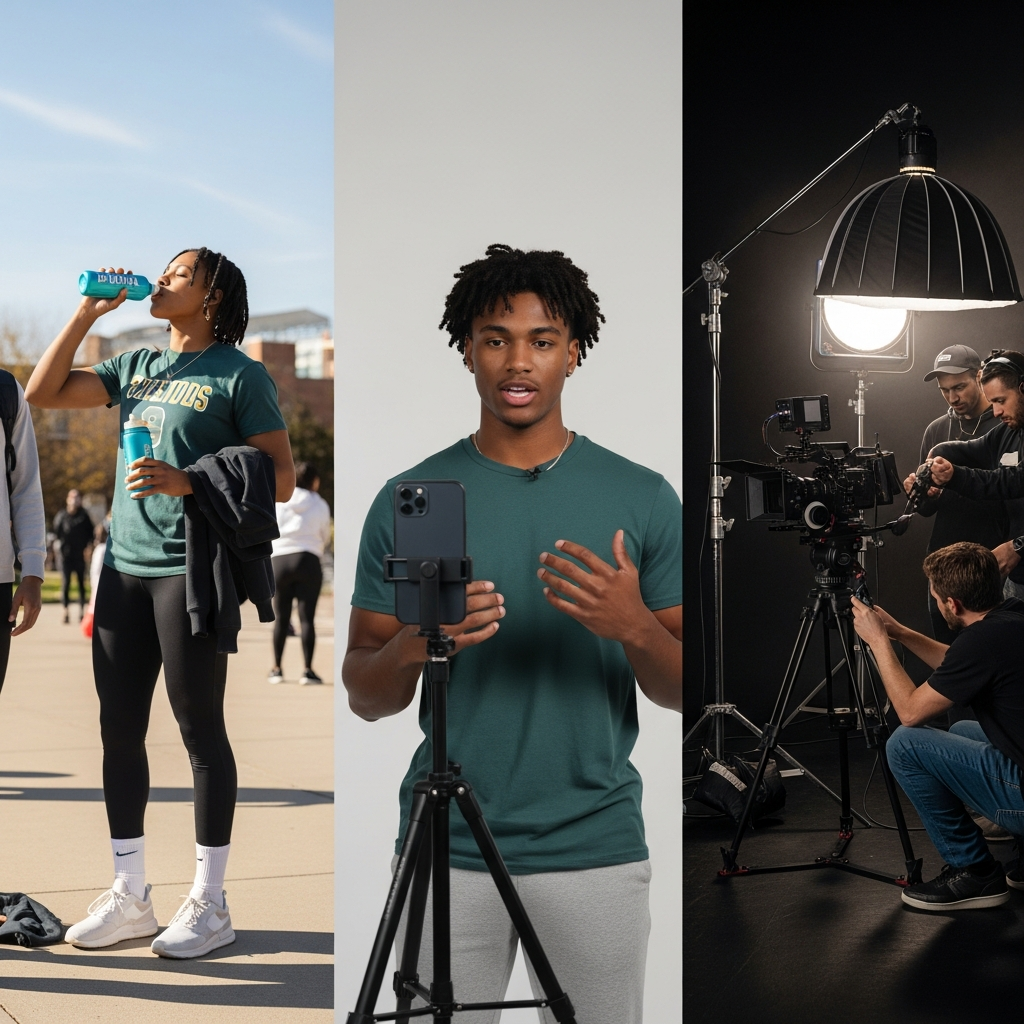
Launchpoint works across the full funnel, and the deal structure reflects that.
Three Deal Types, One System
- Native deals place your brand subtly inside content creators were already planning to post, driving organic awareness at a low CPM up to 1M views.
- UGC deals use in-app templates and creation tools to build explicit product content at scale, built for paid amplification and search rankings.
- Production deals get you downloadable video assets without requiring a live post at all.
That last one matters if you're running paid media and need fresh creative, or if you're a service, app, or event brand without physical product to ship.
Brands approve every video before it goes live and own full rights to everything. Scripts, captions, and on-screen text get keyword-optimized inside the app, so the content is built to rank.
Social SEO and Discoverability
Most influencer content has a short shelf life. It gets posted, gets seen for 48 hours, and disappears. Statusphere's model reflects this. Content is built for immediate social proof and ad repurposing, not search. Volume can produce incidental search visibility, but that's a byproduct, not the architecture.
Launchpoint treats social search as a channel worth building into the content itself. Scripts, captions, and on-screen text are keyword-optimized inside the app before posting. Content is built to rank on TikTok, Instagram, and YouTube from the start.
The numbers make this worth paying attention to. According to Statista, 41% of US consumers used TikTok as a search engine in 2024, and that share has only climbed as social search adoption accelerates into 2026.
Self-driving format improvement keeps testing what performs and adjusts automatically. Instead of a single post with a two-day window, you're building a library of content that compounds search value over time.
Campaign Control and Brand Safety
Statusphere's automated matching uses 300+ data points to pair creators with brands. The system works, but control stays limited. Creators opt into campaigns themselves, and content preview before posting isn't guaranteed. For brands with strict messaging guidelines, that's a real gap.
Launchpoint takes the opposite approach. Brands build custom creator lists filtered by demographics, sport, school, engagement rate, and social app. AI screens every video before it reaches your queue, and nothing posts without your sign-off. You're approving what will go live, not reacting to what already did.
The media browser lets you search creators, save top performers, and filter by campaign history. Pre-built segments like "Top 20% Creators" give you a strong starting point without manual sorting.
The Trust Score System
There's also a built-in accountability layer worth knowing about. Creators who accept product and don't post lose deal access entirely. That consequence is automatic, not dependent on your team chasing anyone down.
Feature | Launchpoint | Statusphere |
|---|---|---|
Creator Network | 20,000+ verified college athletes across 1,000+ US colleges with real campus credibility and natural social standing | Large pool of anonymous micro-influencers matched using 300+ data points covering demographics and engagement history |
Content Strategy | Full-funnel coverage with native deals, UGC deals, and production deals. Content optimized to rank in TikTok, Instagram, and YouTube search with keyword-targeted scripts and captions | Product seeding model focused on unboxings, reviews, and lifestyle posts. Content built for immediate social proof and repurposing, not search visibility |
Approval Process | Brands approve every video before it goes live. AI screening filters content first, nothing posts without explicit sign-off | Creators post on their own timeline after receiving product. Limited pre-approval options, brands often react to already-posted content |
Content Longevity | Videos built to compound search value over months through keyword optimization and social SEO architecture | Content has 48-hour window for visibility, then disappears. Search visibility is incidental byproduct, not designed outcome |
Brand Safety & Control | Custom creator lists filtered by demographics, sport, school, engagement rate. Trust score system automatically removes creators who don't deliver | Automated matching system pairs creators to brands. Control stays limited with creator opt-in model |
Best For | Brands needing full-funnel content, social search visibility, paid ad creative, or selling services/apps/events without physical product | Enterprise CPG and beauty brands focused purely on product review UGC at volume with physical inventory to ship |
Why Launchpoint is the Better Choice
Statusphere has a clear use case. If you're an enterprise CPG or beauty brand that needs a steady stream of product review UGC and has physical inventory to ship, it delivers on that promise reliably.
But that's a narrow mandate. Product seeding at the consideration stage is one slice of creator marketing, not a full strategy.
Launchpoint covers the entire funnel, from awareness content that never mentions your product to conversion-ready paid ad creative. The athlete network brings cultural credibility that anonymous micro-influencers can't replicate. Social SEO builds search visibility that compounds over months instead of 48-hour windows. And the control layer means you're approving content before it goes live, not cleaning up after.
Here's the real difference: Statusphere gets you content. Launchpoint gets you content that builds something. If category authority and long-term discoverability matter to your brand, the choice is clear.
Final Thoughts on the Statusphere Comparison
Statusphere handles product seeding well: ship product, collect UGC, move on. Launchpoint gives you verified athletes, full creative control, and content that owns the search terms your customers actually use, and you can see how it stacks up against other micro influencer platforms before you decide. If that sounds better than generic UGC at scale, book 30 minutes and we'll show you how it works.
FAQ
How do I decide between Launchpoint and Statusphere for my brand?
If you're a CPG brand that only needs product review content and has physical inventory to seed, Statusphere handles that reliably. If you need full-funnel coverage from awareness to conversion, want content built to rank in social search, or sell services/apps/events where there's nothing to ship, Launchpoint is the right choice.
What's the main difference in how content gets created and approved?
Statusphere ships products to matched creators who post on their own timeline with limited pre-approval. Launchpoint lets you approve every video before it goes live, uses AI screening to filter content first, and builds keyword-optimized scripts inside the app so content ranks in search from day one.
Who is each tool actually built for?
Statusphere works for enterprise beauty and CPG brands focused purely on collecting UGC at volume for repurposing. Launchpoint is built for brands that want creator marketing to drive awareness, build search visibility over time, and generate paid ad creative, all from verified college athletes with real credibility in Gen Z.
Can I use either tool if I don't have a physical product to send?
No with Statusphere; their entire model requires product seeding. Yes with Launchpoint. Production deals get you downloadable video assets without requiring product shipment or a live post, which works for apps, services, events, and brands testing creative before launch.
How long does it actually take to get a campaign running?
Most Launchpoint campaigns go from intake to live content in under 24 hours because creator onboarding, contracting, and payouts are automated. Statusphere's timeline depends on product shipping, creator opt-in, and when they choose to post after receiving the item.