Creative Fatigue -38% Rule
Learn why top advertisers kill ad creative at -38% performance drop, not -53%. Protect brand equity and preserve audience goodwill. April 2026 guide.


Your ROAS is sliding, and you're trying to decide if the ad needs another week or if it's done. Here's what separates top performers from everyone else: they kill creative at -38% performance drop, while bottom performers wait until -53%. Understanding the right creative fatigue ad performance threshold matters because that 15-point gap is where brand sentiment turns from indifference to active resistance. Pull at -38% and your next creative gets a fair shot. Wait until -53% and you're spending budget to recover from damage before you can start converting again.
What Creative Fatigue Actually Costs (And Why Most Brands Catch It Too Late)
Creative fatigue is straightforward to define: your ad runs long enough that the audience stops responding. CTR drops, ROAS slides, CPM climbs. Most teams notice only after the damage is done.
The cost goes further than wasted spend. Consumers who experience ad fatigue are 22% less likely to recommend a brand they've seen over-advertised. That's a brand problem, not a media buying problem. You're actively eroding the goodwill it took months to build.
"61% of consumers are less likely to buy from a brand when they see its ads too often. 59% say repeated ads create a negative viewing experience."
The real gap shows up in response timing: top-performing advertisers pull creative at a -38% performance drop. Bottom performers wait until -53%. That 15-point difference sounds small until you account for what's happening to brand sentiment during those extra weeks of overexposure. The laggards aren't losing performance alone. They're losing future buyers.
The -38% Performance Drop Rule: What Top Performers Know That You Don't
The gap between -38% and -53% is where brand equity quietly bleeds out. Top performers treat the -38% threshold as a hard stop, not a warning sign to monitor for another two weeks. Bottom performers treat decline as temporary and keep running, hoping for a reversal that rarely comes.
Here's what separates the two groups: top performers pull creative while it still has residual value. The audience hasn't fully soured yet. There's still goodwill in the tank. Pulling at -38% means your next creative launches into an audience that's slightly fatigued, not actively hostile.
Wait until -53%, and you're recovering from damage instead of managing a transition. That recovery costs real money: higher CPMs to re-engage burned audiences, longer ramp-up periods for new creative, and suppressed conversion rates that linger even after the old ad is gone.
The threshold isn't arbitrary. It's where declining returns stop being recoverable.
Why the Difference Matters in Practice
Think of it as two distinct states your audience can be in when new creative hits them.
- At -38%, your audience is indifferent. They've seen enough of the old ad to tune it out, but they haven't built up active resistance. New creative gets a fair shot.
- At -53%, your audience is conditioned to dismiss you. The new creative has to spend its early budget fighting that conditioning before it can start converting.
That conditioning gap is the real cost of waiting too long, and it won't show up cleanly in your post-campaign report.
Early Warning Signals That Predict Creative Fatigue Before ROAS Collapses
ROAS is a lagging indicator. By the time it drops meaningfully, the fatigue has already set in. The signals you want are upstream, showing up days or weeks before conversion rates fall off.
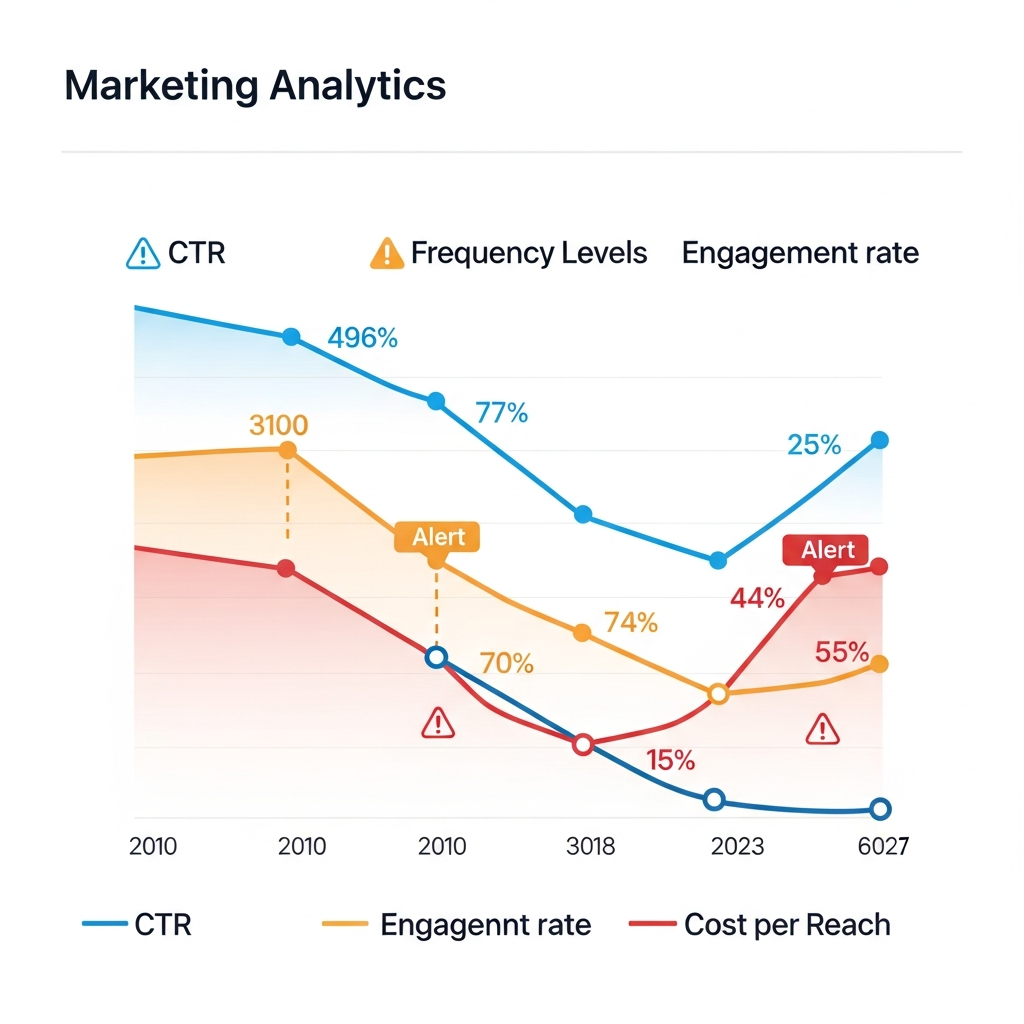
Watch these four metrics as your early warning system:
- CTR degradation week over week: a steady 20-30% weekly decline is normal as an ad matures. Faster than that, something else is broken. Slower is not necessarily good either, since stagnant CTR often masks rising frequency.
- Frequency thresholds by audience segment: when average frequency climbs past 3-4 in a 7-day window for a tight audience, you are recycling impressions and paying to re-annoy the same people.
- Engagement decay patterns: comments and shares drop before CTR does. If your engagement rate is falling while clicks hold steady, the audience is converting on inertia, not interest. That breaks soon.
- Cost per unique reach: when this rises sharply, your reach is shrinking. The algorithm is struggling to find new eyes because it has already served everyone it can.
None of these alone signals retirement. Together, they tell you whether you're managing a normal creative lifecycle or running past the point of recovery.
| Metric | Healthy Range | Warning Zone | Critical Threshold | Action Required |
|---|---|---|---|---|
| CTR Week-Over-Week Decline | 20-30% gradual decline as ad matures | 35-45% decline in single week | 50%+ decline or continuous 40%+ over two weeks | Prepare replacement creative immediately, test new concepts in parallel |
| Average Frequency (7-day window) | 1.5-2.5 impressions per user | 3.0-4.0 impressions per user | 4.5+ impressions per user | Implement frequency caps or expand audience segments to reduce saturation |
| Performance Drop from Peak | 0-25% decline with stable trend | 26-38% decline with continuing downward trend | 38%+ decline (top performer threshold) or 53%+ (recovery damage zone) | Retire creative at -38% to preserve brand equity, avoid waiting until -53% |
| Engagement Rate Trend | Stable or slight decline proportional to CTR | Engagement dropping faster than CTR by 20%+ differential | Engagement collapsed while CTR holds steady on inertia | Full conceptual pivot required, beyond creative refresh or visual update |
| Cost Per Unique Reach | Stable or declining as algorithm optimizes | 15-25% increase over baseline | 30%+ increase indicating audience pool exhaustion | Expand targeting parameters or retire creative before CPMs become unsustainable |
| CVR Relative to CTR | Both metrics move proportionally in same direction | CTR stable but CVR declining 15%+ | CVR dropped 30%+ while CTR holds or both collapsed together | CVR alone declining signals message fatigue; both declining requires full concept change |
Why Frequency Caps Alone Won't Save Your Creative (But They Buy You Time)
Frequency caps are the first thing teams reach for when fatigue sets in. Set a cap at 2-3 impressions per week, slow the burn rate, buy yourself a few extra days of viable performance. It works, to a point.
The problem is that frequency management controls exposure, not exhaustion. Your audience tires of the ad itself. A cap slows the timeline to fatigue without changing the destination.
What Frequency Caps Actually Do
- Extend creative lifespan by slowing impression accumulation in tight audiences
- Reduce early-stage burnout in retargeting pools where the same users cycle repeatedly
- Buy time to build new creative before ROAS collapses
What they won't do is reset audience sentiment. Once a creative has conditioned users to skip or ignore it, lowering frequency just means they ignore it less often, while you pay to keep it running.
Above 2.5 impressions per week is where most campaigns start seeing measurable performance decline. Caps help you stay below that ceiling. They do not raise it.
Use frequency caps as runway, not rescue. The goal is to manage your current creative's decline rate while building what comes next. If your creative pipeline depends on caps to stay viable, you are already behind.
The Creative Refresh Paradox: When Changing Everything Changes Nothing
Most teams treat a creative refresh like a coat of paint. New colors, new headline, same hook, same value prop. Performance barely moves, and they blame the audience.
The audience isn't wrong. Message fatigue drives most creative fatigue, not visual fatigue. If your core claim has worn out, reskinning it just wraps the same tired idea in a new package.
To diagnose which you're dealing with, look at where the funnel breaks.
CTR vs. CVR as a Diagnostic Signal
- If CTR holds but CVR drops, the click is working but the message isn't converting. That's message fatigue. A new concept won't fix it; the offer or landing experience needs rethinking.
- If both CTR and CVR drop together, the ad has lost attention before it even earns the click. That calls for a full conceptual pivot, not a headline swap.
How UGC Content Resets Fatigue Clocks (With 4x Better Performance)
Brand-produced ads share one fatal trait: they are identical every time someone sees them. Same actor, same setting, same edit. UGC breaks that pattern structurally. Each creator brings a different face, environment, energy, and delivery even when the brief is identical. The product is the same. Everything around it changes.
That variation is why UGC ads generate 4x higher click-through rates and 50% lower cost per click than standard brand content. Each creator brings distinct visual context and delivery style. Audiences process each version as a separate encounter, which slows the recognition-and-skip reflex that drives fatigue.
Running 10 creators against the same brief gives you 10 different fatigue clocks running in parallel, not one clock counting down on a single asset.
Why Your Best-Performing Ad Is Your Biggest Creative Fatigue Liability
Winning ads get punished by the same algorithms that reward them. When Meta or TikTok identify a high-performing creative, they concentrate delivery toward your best-converting segments. That sounds like a good thing until you realize concentrated delivery means concentrated frequency. Your audience saturates faster.
Algorithm-driven campaigns can accelerate fatigue onset by up to 35% compared to manually structured ones. Your best ad hits its ceiling sooner precisely because the algorithm worked.
The implication is counterintuitive: rotate your top creative before performance drops, not after. Pulling a winner while it still performs feels wasteful. Waiting for the algorithm to surface the decline means you have already paid for the damage.
Building a Self-Refreshing Creative System (Beyond More Ads)
Most creative fatigue problems are pipeline problems. Teams produce one concept, run it until it breaks, then scramble to replace it. That cycle guarantees reactive decisions under pressure.
A self-refreshing system treats creative as modular. You separate the hook, the format, the creator, and the core message into interchangeable parts. When one element fatigues, you swap it without rebuilding everything else.
In practice, this looks like:
- A standing roster of creators briefed on your product, ready to produce on short notice
- 3-5 evergreen content formats that can be refreshed with new talent each month
- Rotating hooks mapped to different audience segments so no single angle runs everywhere simultaneously
The creator roster is the hardest part to build and the easiest part to systematize. Working with a network that continuously supplies verified creators means your refresh cycle runs on their schedule, not your production calendar.
How Social Search Changes Creative Fatigue Strategy in 2026
Feed ads interrupt. Search content answers. When someone searches "best pre-workout for athletes" on TikTok, a relevant video feels useful instead of intrusive, so the skip reflex barely applies.
That demand-pull model extends effective creative lifespan considerably. Feed ads fatigue because repeated exposure builds resistance. Search content gets found fresh each time by a new searcher, meaning a well-optimized video can perform months after a standard feed ad would have burned out.
With 46% of Gen Z using social media as their primary search tool, the volume behind this channel is real. Two in five Americans now use social platforms as search engines.
Refresh requirements here are lower, but the stakes around initial quality are higher. A search-optimized video either ranks or it doesn't.
Scaling Fresh Creative Without Scaling Production Costs: The Launchpoint Approach
Centralized creative production has a ceiling. You can hire more designers and brief more concepts, but cost scales with volume. That's the wrong model for solving a fatigue problem that requires continuous creative variation.
Distributed production flips the equation. With 20,000+ verified creators, each campaign produces dozens of distinct assets from different faces, locations, and delivery styles, all working from the same brief. Costs stay flat while creative variation compounds.
AI quality checks, a trust score system, and automated management handle what makes creator volume impractical at scale: screening, approvals, payments, and compliance. Brands approve what they like and skip what they don't. The refresh cycle runs continuously without a production bottleneck driving the timeline.
Final Thoughts on Creative Refresh Strategy
You can't solve creative fatigue with better timing if your production can't keep pace with your media spend. Top performers pull creative early because they have replacements ready, not because they're more disciplined. If you're curious what a standing creator roster actually costs compared to your current scramble-and-produce cycle, grab time here to walk through it. The refresh problem gets easier once the pipeline isn't your bottleneck.
FAQ
Can I build a creative refresh system without scaling production costs?
Yes. Distributed creator production keeps costs flat while multiplying creative variation. Working with a verified creator network produces dozens of distinct assets from different faces and environments, all from the same brief, without increasing per-unit costs the way centralized production teams do.
What's the main difference between -38% and -53% creative retirement thresholds?
Top performers pull creative at -38% performance drop while the audience is indifferent but not hostile, giving new creative a fair shot. Bottom performers wait until -53%, by which point the audience actively dismisses the brand, forcing new creative to spend early budget fighting conditioning before it can convert.
When should I retire ad creative before ROAS drops?
Watch CTR degradation, frequency above 3-4 in a 7-day window, engagement decay before clicks fall, and rising cost per unique reach. These signals appear days or weeks before ROAS collapses, giving you time to rotate creative while residual value remains.
UGC vs brand-produced ads for creative fatigue?
UGC resets fatigue clocks because each creator brings a different face, setting, and delivery even with identical briefs. Audiences process each version as distinct instead of recognizing and skipping the same ad. This generates 4x higher click-through rates and 50% lower cost per click compared to brand content.
How does social search change when to retire ad creative?
Search-optimized videos last months longer than feed ads because they answer demand instead of interrupting. Someone searching "best pre-workout for athletes" finds your content fresh each time, avoiding the repeated exposure that builds resistance in feed placements.