

When you launch content creator advertising campaigns, you're building assets that either convert or waste budget. The problem is that most teams can't tell the difference until they've already spent the money. Views tell you nothing about revenue impact, and engagement rates only matter if they lead to sales. We'll break down the exact metrics that separate high-performing creator content from expensive content that just looks good.
TLDR:
- Creators drive 94% higher trust than traditional ads and 53% higher click-through rates
- Smaller creators with under 5,000 followers convert 20% better than larger influencers
- US influencer marketing spending will grow 15.7% in 2026, crossing $10 billion annually
- TikTok Spark Ads using creator content deliver 25% higher CTR and 24% higher CVR than standard ads
- Launchpoint automates creator campaigns with 20,000+ verified student athletes across 535 campuses
What Is Content Creator Advertising
Content creator advertising is when brands pay creators to make promotional content for social media. Instead of producing ads in-house or through agencies, you partner with individuals who already have audience trust and know how to make content that performs on TikTok, Instagram, and YouTube.
The difference from traditional ads? Creator content doesn't look like an ad. It shows up in feeds as native content that people choose to watch, not interrupting their experience. Creator endorsements drive 94% higher trust than traditional ads. That trust translates into performance, especially in today's short-attention-span environment.
Brands use creators for four main content types: direct product showcases, verbal mentions in existing content, natural integrations where the product appears organically, and watermarked videos where the brand is subtly present throughout. Each serves different funnel stages.
Why Content Creator Advertising Drives Better Performance Than Traditional Ads
Here's the real performance gap: 58% of consumers have purchased based on influencer endorsements, while only 38% trust brand recommendations directly. That 20-point spread shows up in every campaign metric.
Partnership ads generate 53% higher click-through rates than standard brand ads. Smaller creators with fewer than 5,000 followers achieve 20% higher conversion rates than larger accounts, proving the engagement paradox. When brands boost creator content through TikTok Spark Ads, they see 25% higher CTR and 24% higher CVR compared to traditional ad formats.
The reason? Algorithms treat creator content differently from brand content. When you post from a brand account, the algorithm assumes it's promotional and limits distribution. When a creator posts the same product, the algorithm reads it as organic content and pushes it to more feeds.
Audiences scroll past polished brand ads. They stop for authentic creator videos that match the native content they're already watching.
The State of Content Creator Advertising Spending in 2026
US influencer marketing spending will grow 15.7% in 2026, following 15.0% growth in 2025 when the market crossed $10 billion. This isn't an experimental budget anymore. It's a core channel investment.
Average influencer marketing budgets jumped 171% year-over-year, with enterprise brands now allocating between $5.6M and $8.1M annually to creator programs. That's more than most companies spend on traditional display advertising.
Creator marketing is expected to triple over the next three years, outpacing every other ad format, including connected TV and programmatic display. Brands aren't testing creator content alongside their main strategy. They're rebuilding their entire paid social approach around it.
The budget allocation reflects what performance data has already proven: creator content converts better, costs less per impression, and generates higher ROAS than in-house ads. C4 Energy's 10% sales lift shows this impact at scale.
Best UGC Platforms for Creators in 2026
The best influencer marketing tools automate the parts most teams waste time on: vetting, contracts, content approvals, and tracking what converts.
What separates basic creator directories from scalable tools? Real-time performance data across TikTok, Instagram, and YouTube. Automated compliance for tax forms and licensing. Fraud filters that catch fake followers before you pay. And content rights management that lets you repurpose creator videos as paid ads without chasing permission months later.
Skip anything that requires manual negotiation per the creator. You need automated matching between briefs and creators, approval workflows with built-in revision requests, and instant payouts tied to performance milestones. The right setup produces approved, on-brand content in days, not weeks.
Types of Content Creator Advertising Campaigns
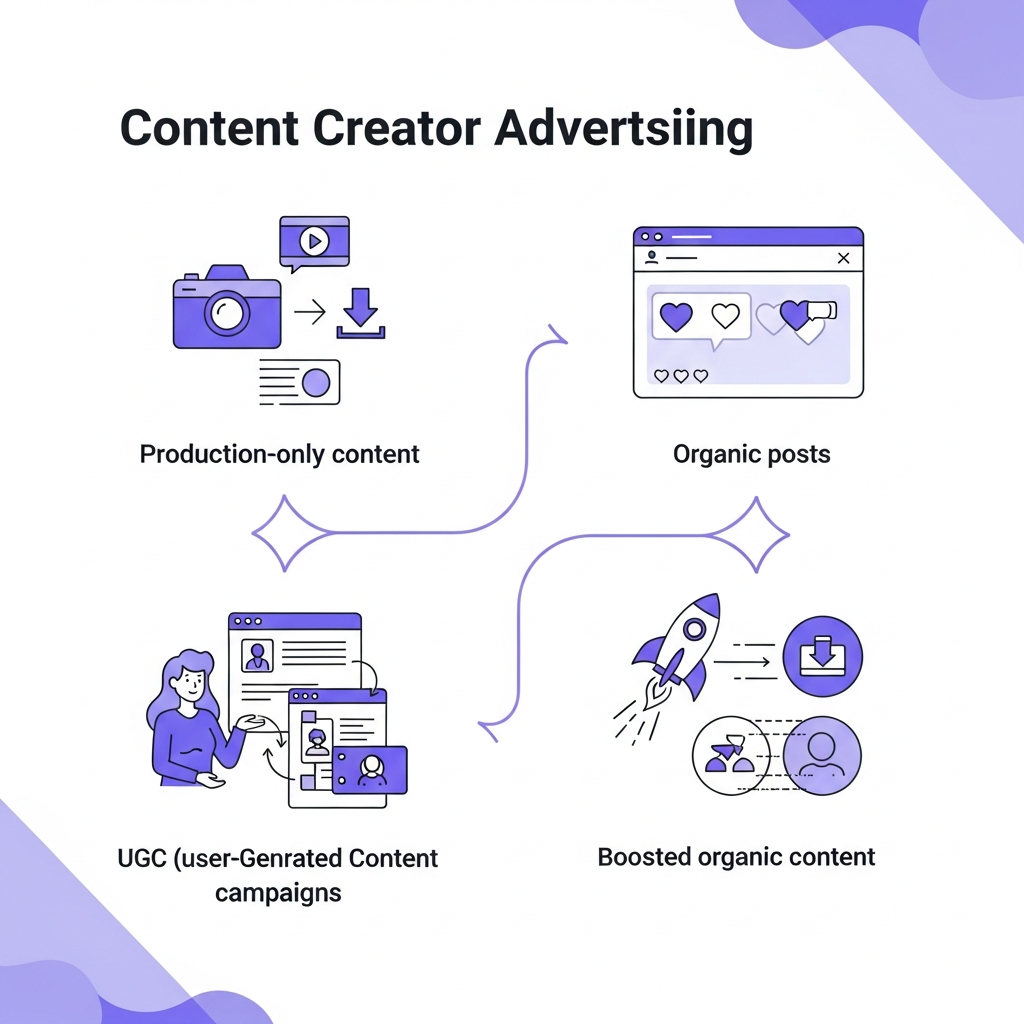
Creator campaigns break into four distinct structures, each serving different funnel goals and budget levels.
Production-only content means creators make videos that you download and use however you want. No live posting required. You pay smaller base rates without CPMs since there's no reach component. Brands use these for paid ad libraries when they need fresh creative fast.
Organic posts put content live on creator profiles. Native integrations work for awareness: creators wear your product or feature it naturally in videos they'd post anyway. You pay low CPMs up to 1M views. These optimize for virality, not conversion.
UGC campaigns with specific instructions serve consideration. Creators follow your brief, copy proven formats, or use in-app templates. You pay base rates plus CPM. These videos rank for search terms and convert to paid ads.
Boosted organic content layers and paid media behind top performers. You take creator posts that already work organically and amplify them through Spark Ads or partnership ads. TikTok Spark codes deliver 25% higher CTR than standard ads, while Instagram partnership ads cut CPA by 19%.
Match campaign type to where customers are in the funnel. Awareness needs volume and virality. Consideration needs credible product explanations. Conversion needs paid amplification behind proven content.
| Campaign Type | Best For | Avg. Cost | Key Metrics | Typical CTR Lift | | --------------------------- | ----------------------------------- | ------------------------------- | -------------------------------------- | ----------------- | | Production-Only Content | Paid ad libraries, creative testing | $100-300 per video | CPA, ROAS, conversion rate | Baseline | | Organic Posts (Native) | Brand awareness, reach | Base rate + low CPM to 1M views | Reach, share rate, engagement | +15-25% | | UGC Campaigns (Scripted) | Consideration, search rankings | Base rate + CPM | Watch time, comment quality, and saves | +30-40% | | Boosted Organic (Spark Ads) | Conversion, retargeting | Organic cost + ad spend | CTR, CVR, attributed sales | +53% vs brand ads |
How to Measure Content Creator Advertising Performance
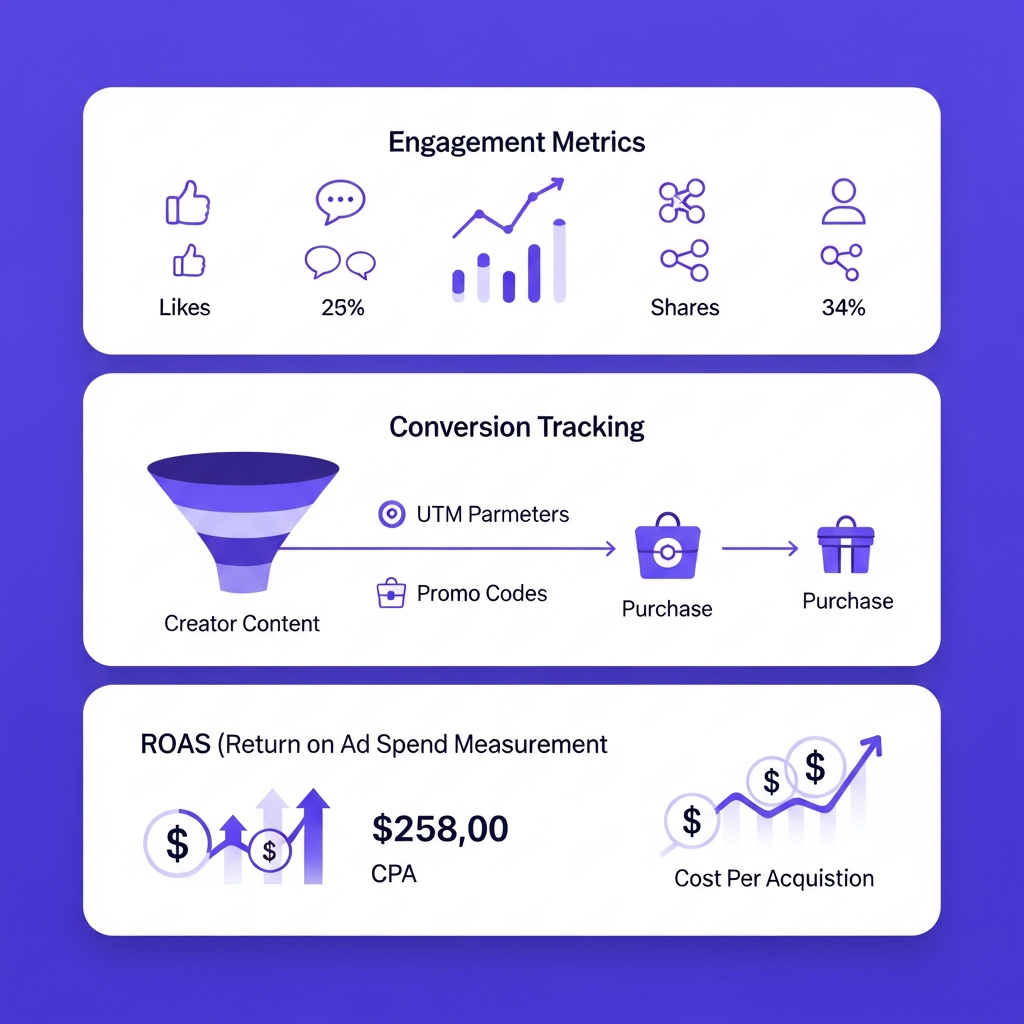
Most brands track the wrong metrics. Views and follower counts tell you nothing about revenue impact.
Quality creative drives 50% of ROI, but only if you track when and how customers engage with specific videos. Start with engagement rate (likes, comments, shares divided by reach), then map those interactions to conversion events in your analytics.
ROAS measurement requires connecting creator content to purchase behavior. Use UTM parameters for trackable links, promo codes assigned to individual creators, and geo-incrementality testing that compares sales lift in markets where creator content runs versus control markets.
Track creative performance by format. Sort videos by cost per acquisition, not view count. Identify which hooks, scripts, and visual patterns drive conversions at the lowest cost.
Break metrics by funnel stage. Awareness content needs reach and share rate. Consideration content needs watch time and comment quality. Conversion content needs a click-through rate and attributed sales.
Content Creator Advertising Strategy for Small vs Large Brands
Small brands need volume fast. Work with creators under 10K followers who charge $100-300 per post (see our full influencer pricing guide for detailed rates). Your budget stretches further, and these accounts convert 20% higher than larger influencers. Run campaigns with 50 micro-creators instead of 5 mid-tier accounts. Learn how to find micro-influencers for your campaigns.
Large brands face different constraints: managing hundreds of creator relationships drains resources. You need systems that handle contracts, payouts, tax compliance, and content approvals without manual work per creator. At scale, administrative overhead kills margins faster than poor content performance.
Budget allocation should flip by company size. Small brands spend 70% on content creation and 30% on paid amplification behind winners. Large brands reverse this: 30% on fresh creator content, 70% on boosting proven formats across paid channels.
In-house management breaks down after 20 active creators. Beyond that threshold, tracking performance and processing payments consumes more hours than sourcing new partnerships.
Common Mistakes in Content Creator Advertising Campaigns
Brands kill creator campaigns by chasing follower counts instead of engagement rates. A creator with 100K followers and 1% engagement delivers worse results than one with 10K followers and 8% engagement. Same budget, 8x less interaction with your product.
Treating creators like billboards destroys performance. When brands demand pixel-perfect scripts and forced product placements, the content reads as fake. Audiences scroll past it. Give creators room to integrate your product naturally in their voice, or pay for content nobody watches.
Stopping campaigns after one creative test leaves money on the table. This is why many influencer campaigns fail. The first video format rarely works best. Brands need to cycle through hooks, video structures, and creator types to find what converts. 61% of consumers are less likely to buy when they see the same ad repeatedly, but that doesn't mean you should kill the campaign. It means refresh the creative.
Requiring approval on every frame creates bottlenecks. Work with vetted creators, set clear boundaries in the brief, then let them post. Trust scores handle accountability better than micromanagement.
How Launchpoint Scales Content Creator Advertising for Brands
Launchpoint removes the bottleneck that kills creator campaigns at scale: management overhead. Once you reach 20 creators, manual management breaks down. Contracts, tax forms, shipping tracking, payment routing, and content follow-ups consume weeks of back-and-forth.
Our network spans 20,000+ verified student athletes across 535 campuses and 35 sports. Athletes bring built-in credibility that affects both algorithm distribution and audience response. Performance data confirms this advantage.
The trust score system automates accountability. When a creator receives a product but doesn't deliver content, their score drops immediately. Low scores block access to future campaigns and reduce payout rates. Creators see which deliverables affect their standing and how much time remains.
Brands launch campaigns in under 24 hours. Set budgets, approve content, and track performance through real-time dashboards. We handle messaging, revision requests, PayPal or Venmo payouts, and year-end 1099 filing.
You pay only for approved videos. Download files, run them as Spark Ads, or let them rank organically. Full usage rights with zero per-creator negotiation required.
Final Thoughts on Scaling Content Creator Advertising
Most brands fail at creator campaigns because they optimize for the wrong variables. Follower counts don't matter. Creative output and conversion rates do. The best UGC platforms for creators handle compliance, payments, and performance tracking so you can focus on finding which hooks and formats actually drive purchases. Test more formats with smaller creators, kill what doesn't convert, and put paid budget behind proven winners.
FAQs
How long does it take to launch a creator advertising campaign?
Most campaigns go live within 24 hours of setting your budget and approving the creator briefs. The actual content production and approval process depends on campaign type: production-only videos typically take 3-5 days, while organic posts with live publishing can appear within 48 hours of creator acceptance.
What's the difference between production-only and organic creator campaigns?
Production-only campaigns pay creators to make videos you download and use as ads without live posting. You pay smaller base rates with no CPM costs. Organic campaigns involve creators posting content live on their profiles, where you pay base rates plus CPM but gain authentic audience engagement and potential virality that production content can't replicate.
When should I boost creator content with paid ads instead of relying on organic reach?
Boost content after it proves itself organically. Look for videos hitting above-average engagement rates in the first 24-48 hours. TikTok Spark Ads deliver 25% higher CTR than standard ads, while Instagram partnership ads cut CPA by 19%. But these numbers only matter when you're amplifying content that audiences already choose to watch.
Why do smaller creators convert better than influencers with large followings?
Creators under 5,000 followers drive 20% higher conversion rates because their audiences trust them more personally and engage at higher rates (often 5-8% engagement versus 1-2% for larger accounts). A creator with 10K followers and 8% engagement delivers 8x more interactions per dollar spent than a 100K-follower account with 1% engagement.
Can I use creator videos as paid ads after they post organically?
Yes, you own full usage rights to approved creator content and can download files to run as Spark Ads, use in paid campaigns across channels, or repurpose for other marketing needs without additional negotiations or permissions per creator.